Monday, 1 September 2014

Beautiful Weeds: Periwinkle

The first time I took any notice of this attractive plant was when I saw it growing in a Canberra garden where it was used as a ground cover beneath a deciduous tree in an island bed. This courtyard bed was surrounded by paving and the periwinkle was the only ground cover used there.  The plant was the lesser periwinkle - Vinca minor and it made an attractive low growing, yet dense, planting.


The distinctive windmill sail petals of the periwinkle

A year or two later I saw blue periwinkle - Vinca major, the larger ornamental species, growing in a large country garden. What appealed were the beautiful bluish single flowers along with the glossy dark green oval leaves. Now smitten by the plant I took a few rooted shoots home to my own garden and with a little care they soon thrived. That relocation was a bad mistake because within a couple of years the periwinkle soon spread throughout the shadier parts of my garden.  Instead of making a dense ground cover the plants habit was wiry and allowed other plants to grow through it. Soon realising that the plant was weedy I decided to rip the plant out of my garden. I now appreciate this beautiful plant in other peoples gardens rather than my own.


Periwinkle is often found growing 
in old cemeteries

The Vinca genus is a member of the Apocynaceae family, a poisonous tribe that includes the oleander and mandevilla.  The larger species is native to the Mediterranean area and prefers moist, shady sites.  Due to its popularity with home gardeners (sorry) the plant has become a garden escape in many areas.


Vinca major 'Variegata' 
growing among Asparagus

Vinca major flowers from late winter to spring. While most colours are bluish purple there is also a white cultivar. Another popular choice is the variegated form. The smaller sized species Vinca minor is native to south-west and central Europe and the Caucasus and grows in similar conditions to its larger cousin. The flowering period also lasts longer, from late winter to early summer. Roger Phillips and Martin Rix in their classic 1991 book Perennials (volume 1) list several cultivars: 'Albo-variegata' has white flowers and gold variegated leaves; 'Argenteo-variegata' has silver edged leaves; 'Atropurpurea' has deep-purplish-red flowers; and 'Flore Pleno' has double purplish-blue flowers, both with green leaves.

© Silas Clifford-Smith 2014

Tuesday, 26 August 2014

Yesterday's Gardens

I was saddened to hear of the recent death of publisher and historian Victor Crittenden OAM (1925-2014). While I can hardly claim Victor to be a close friend he was always friendly and willing to help historians and writers that shared his research interests. Below is my old review of his important work Yesterday's Gardens.


Yesterday's Gardens: a History and Bibliography of Australian Gardening Books 
By Victor Crittenden [2002]

This is a book for librarians and keen collectors of Australian garden books. The first edition was published a decade earlier, and it soon became an intellectual challenge among garden historians to find works not listed in the original edition.

Crittenden lists 208 books in this updated edition and chronological lists all garden related books published up to 1950. Notable publications listed include Thomas Shepherd's Lectures on Landscape Gardening in Australia (1836), E W Cole's (1880s) Coles's Penny Garden Guide, and the better known Yates Garden Guide which was first published in 1895.

The first garden publications date from the early 19th century and were often simple garden calendars published in Almanacs. According to Crittenden, the first locally produced garden publication was the New South Wales Pocket Almanac and Remembrancer for the year of our Lord and Savior 1806. By the second half of the 19th century more and more garden books were published and titles became less verbose. I especially love A E Coles's 1922 Half-hours in the Bush House, a title that may disappoint some non-gardeners.

While Yesterday's Gardens will appeal only to a small market, the author should be applauded for his research in producing this fascinating publication.

Yesterday's Gardens: a History and Bibliography of Australian Gardening Books 
By Victor Crittenden [2002]
Mulini Press, Canberra
276 pages, hardback, RRP A$50.00
ISBN 0949910-90-2

Post-script
Victor Crittenden's obituary was published in the July-September 2014 issue of Australian Garden History. 

Thursday, 3 July 2014

Veltheimia

I noticed today that the flower buds on my Veltheimias were starting to stand proud, surely a sign that we have reached mid-winter the peak growing time for this little used garden plant. I first came across Veltheimia bracteata several years ago when working at historic Vaucluse House, where it was planted in dappled-shade on a gentle-sloping bank between a garden path and some camellias.

Veltheimia bracteata flowers about to 'blow'

The two species of Veltheimia come from South Africa and are named after a certain count of Veltheim (whoever he was).  A small growing bulb, the foliage grows to about 30cm tall, and the plant looks a little like Lachenalia or small Kniphofias. While easy to grow this plant requires good drainage and a half decent garden soil. While I have used them in gardens I find that Velthemia make great outdoor pot plants, and they look wonderful growing on my antique wire-work plant stand. When grown in a container use a good quality potting mix without water-holding crystals. Plants form a glossy rosette of leaves in early winter and they flower later in the season.  While most blooms are coral pink, some varieties have cream or yellow flowers. During summer the foliage dies down and I retire my pot to a dry and shady part of the garden during its dormancy. If planted in the soil the bulbs can be left in the ground as long as they don’t get too wet. The best time to transplant or divide is in autumn. Plants can be propagated from seed or offsets removed from the main bulb in late summer.


Veltheimias in full bloom 

Every garden should have a few unusual plants and this South African bulb is definitely worth trying, I promise you will be asked about it when it’s in bloom. While hardly a rare plant, Veltheimia can be sourced from specialist bulb nurseries such as Sue and Garry Reid's rare and speciality bulb nursery in northern Victoria. The Reids have a mail order service and can be contacted at 43 Wallace Road, Allans Flat, Victoria 3691 (tel 02: 6027 1514)

Saturday, 1 February 2014

Antique wire work plant stands

The 19th century saw the rise of ornamental gardening as a popular recreational pursuit for the middle classes. The prominent use of pots and containers for displaying plants became a major feature of this time both inside and outside the home. 


The popularity for growing plants in pots led to to the development of display stands to show them off. Ornate metal plant stands first found popularity during the early years of the 19th century but became increasingly popular from the 1840s up to the early years of the following century. Sometimes home owners maintained the display while in more wealthy homes the gardener was responsible for the watering and care of the pot plants on these stands. 

A beautiful example of an original wire work 
garden stand complete with reproduction 
Victorian hand-thrown terracotta pots 
and popular 19th century plants

Plant stands had been popular with the wealthy in the 18th century and were made of metal or ornate stone such as marble. Improvements in metallological techniques during the Industrial Revolution saw cheaper products being made. Light weight wire-work stands became popular and were commonly found positioned in conservatories, ferneries or on verandas. Most stands were sold through the newly established department stores. Surviving department store catalogues attest the the large range of designs and sizes available.

An array of wire-work plant stands on offer from the
catalogue of the Army and Navy Stores in London

These days original examples are rare, and if found are often in need of repair. Most surviving original wire work stands show the effects of rust damage, and this is especially true in humid areas close to the sea. Conservation work should be done by someone who appreciates the historic qualities of these pieces as an over restored piece will just look like a brand new reproduction stand.


My own antique wire work stand
in urgent need of conservation work
After the First World War wire work plant stands were perceived as old fashioned and ceased to be sold by retailers. Nostalgia for these items has seen the production of reproduction wire work stands based on original designs. Often these copies fool buyers at auctions or in antique shops, believing that their new purchase is an original.


Thursday, 14 November 2013

A family worth knowing

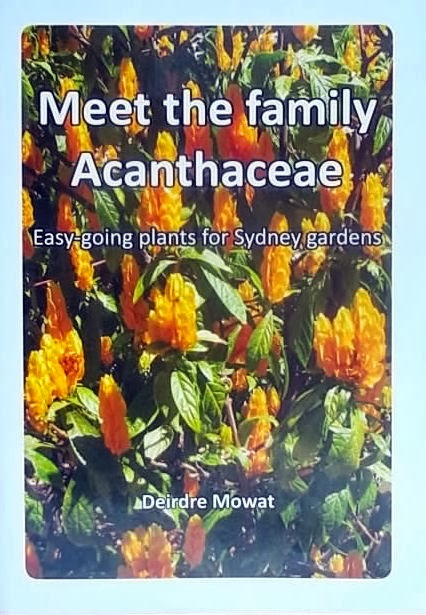
I recently came across a cheaply priced booklet at a book sale about the large and diverse Acanthus family. For those who like informative books about ornamental gardening without the bells and whistles this little reference will certainly delight. The author extols the charms of the many ornamental plants of the Acanthaceae family, a large tribe best known by the well-known cool climate Acanthus or oyster plant.


Apart from Acanthus, this family includes many brassy sub-shrubs, such as Justicia and Megaskepasma, that love frost-free warm temperate climates. While this booklet is aimed at a Sydney audience it will also appeal to gardeners in similar climatic locations around Australia. My only criticism of the recommendations was the lack of warning of the weed potential of some members of the Ruellia genus in this family.

With the exception of Acanthus most of Mowat's recommendations are generally not available at most plant nurseries as when young these plants lack flowering charm. The author suggests sourcing plants at the excellent Friends of the Royal Botanic Gardens plant nursery in Sydney. It would have been helpful that other specialist nurseries selling these plants were listed. Despite a couple of minor gripes I highly recommend this booklet.

Meet the family Acanthaceae: easy going plants for Sydney gardens
By Deirdre Mowat [2012]
Self published
31 pages, softback, RRP $12 (including delivery) from authors website igarden.com.au/acanthus.jsp

Thursday, 17 October 2013

The Hardware Garden

Sometime back, I received a call from a Scottish woman asking for my gardening help. The lady - let’s call her Morag - asked whether I trimmed hedges as she needed urgent help cutting one in her back garden. I was asked to do the trim as her husband – let’s call him Don - was suffering from severe back pain and was unwilling to climb their wobbly wooden ladder.


My first impression of Morag and Don’s garden was that it was immaculately maintained, and it came as no surprise when they told me that their garden was a regular entry in the ‘medium-sized’ category of their local council’s annual spring gardening competition. Don noted that they had entered the contest for several years but he was mystified why they had never won.

What struck me was that while the garden was well designed and maintained none of their plant selections were distinctive or unusual and the garden was, quite simply, dull. The only concessions to Art in the back garden were a couple of painted concrete sculptures of kneeling 'naked ladies' near the swimming pool and a composite stone head of Buddha. It was no wonder that in the garden judges’ collective mind this uninspired block was soon forgotten in deference for gardens with a touch of the inspired.

Reflecting on this couples lack of success made me think whether it was possibly to create a distinctive garden from plants and pots totally sourced from supermarkets and hardware shops. Many people are increasingly buying their plants this way rather than from the traditional specialist plant nurseries. To answer this question I decided to view the offerings available in several local stores.

Coles and Woolworth's are long established in Australia and have sold seeds, fertiliser and garden fittings for many decades and along with Kmart branched out into selling garden plants as a way to attract new customers into their stores. While most of their plants are not expensive their stock has gained a reputation as being in poor condition due to light deprivation and sparse watering regimes. Perhaps in reaction to this public perception most supermarkets have begun to abandon selling live plants over the last few years.

Customers traditionally lured by one-off purchases and cheap plants found in supermarkets have increasingly moved to the nursery sections of the large hardware barns such as Bunnings. These large concrete box retailers have only been in Australia for a short time and based on experience in the North American market have set up nursery sections as a way to lure customers away from the supermarket sector and the traditional nursery trade.

Early on the big barn nursery sections in Australia were poorly managed and the plants were in as dire a condition as the stock of their supermarket rivals. But, over the last few years the barns have got their act together and have learnt that plants have different display and maintenance needs to nails and PVC piping. The management improvement of these areas may account for the demise of the supermarkets foray into horticulture.


Most of the plants found in the barn nurseries are well grown and generally in good condition but offer little to the serious gardener looking for something unusual. Despite the quality of the stock the variety is limited and like the hardware items found inside, the prices are not always cheap. Sadly, the trend towards large monopoly retailers has seen the demise of many small individual nurseries who offered expert advice as well as a comprehensive range of stock.

While many plants can be found in hardware barn nursery sections, visits to specialist garden centres and plant fairs will certainly give your garden the magic touch. Making distinctive gardens doesn't necessarily mean having a bottomless budget, but it requires a genuine love of plants and the interest in finding a place for the unexpected, be it plant or sculpture. If only Don and Morag had explored the unusual in the plant and sculpture world they may have won greater accolades for their hard work.

I'm interested in what you think about this major change in the way we buy plants. Is it a good thing?

Wednesday, 25 September 2013

Floral flags

All my life I have loved flags and pennants even though I'm no nationalist flag waver. Most national flags are simple abstract variations of bold colour blocks, as in the French, British or German ensigns, while another popular design variant is the addition of celestial symbols such as the sun, moon and stars, as found in the flags of the United States, Australia, China, Japan and Turkey. Other designs include religious symbols, crests and weapons.

1983 design by Austrian-born artist Friedensreich Hundertwasser
 for the New Zealand national flag, based on an unfurling fern frond
Sadly this design has not been adopted

As a plant lover I was curious to find examples of botanical imagery used in national flags. After some research I found there were surprisingly few sovereign state flags which fit this criteria. While floral emblems are more common in provincial or sub-ordinate political entities flags (such as Hong Kong or Australia's Northern Territory) they are absent from most national designs; perhaps floral imagery is not macho enough for a national symbol.

Arguably, the best known national ensign using a botanical motif is the Canadian flag which was adopted in 1965. The central feature is a single leaf of the endemic sugar maple (Acer saccharum). While the colour is striking the leaf colour of this plant turns dramatically red prior to leaf drop in Autumn.


[Flag ofCanada]
The Canadian flag must be one of the most identifiable flags in the world

After the Canadian flag, the best known flag using a botanical image is that of Lebanon. Their flag includes a stylised Cedar of Lebanon tree (Cedrus libani) at the centre of the design. This conifer is one of the most attractive trees found in nature and makes a fine choice for a national symbol. With all the tensions in that part of the world this symbol is loved and respected by all Lebanese be they Muslim or Christian. What more would you want from a national flag?


File:Flag of Lebanon.png
The flag of Lebanon

Sadly, there are few other botanical examples apart from the Cypress flag which includes olive branches and the British Indian Ocean territory flag which includes a palm. I'm sure I've missed other examples. If I have please let me know.


Related Posts Plugin for WordPress, Blogger...