Saturday, 1 February 2014

Antique wire work plant stands

The 19th century saw the rise of ornamental gardening as a popular recreational pursuit for the middle classes. The prominent use of pots and containers for displaying plants became a major feature of this time both inside and outside the home. 


The popularity for growing plants in pots led to to the development of display stands to show them off. Ornate metal plant stands first found popularity during the early years of the 19th century but became increasingly popular from the 1840s up to the early years of the following century. Sometimes home owners maintained the display while in more wealthy homes the gardener was responsible for the watering and care of the pot plants on these stands. 

A beautiful example of an original wire work 
garden stand complete with reproduction 
Victorian hand-thrown terracotta pots 
and popular 19th century plants

Plant stands had been popular with the wealthy in the 18th century and were made of metal or ornate stone such as marble. Improvements in metallological techniques during the Industrial Revolution saw cheaper products being made. Light weight wire-work stands became popular and were commonly found positioned in conservatories, ferneries or on verandas. Most stands were sold through the newly established department stores. Surviving department store catalogues attest the the large range of designs and sizes available.

An array of wire-work plant stands on offer from the
catalogue of the Army and Navy Stores in London

These days original examples are rare, and if found are often in need of repair. Most surviving original wire work stands show the effects of rust damage, and this is especially true in humid areas close to the sea. Conservation work should be done by someone who appreciates the historic qualities of these pieces as an over restored piece will just look like a brand new reproduction stand.


My own antique wire work stand
in urgent need of conservation work
After the First World War wire work plant stands were perceived as old fashioned and ceased to be sold by retailers. Nostalgia for these items has seen the production of reproduction wire work stands based on original designs. Often these copies fool buyers at auctions or in antique shops, believing that their new purchase is an original.


Thursday, 14 November 2013

A family worth knowing

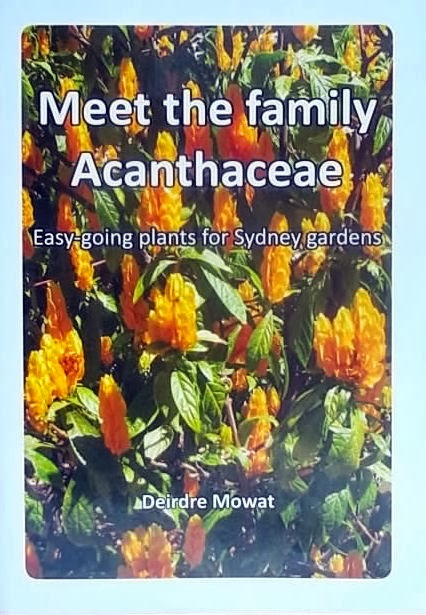
I recently came across a cheaply priced booklet at a book sale about the large and diverse Acanthus family. For those who like informative books about ornamental gardening without the bells and whistles this little reference will certainly delight. The author extols the charms of the many ornamental plants of the Acanthaceae family, a large tribe best known by the well-known cool climate Acanthus or oyster plant.


Apart from Acanthus, this family includes many brassy sub-shrubs, such as Justicia and Megaskepasma, that love frost-free warm temperate climates. While this booklet is aimed at a Sydney audience it will also appeal to gardeners in similar climatic locations around Australia. My only criticism of the recommendations was the lack of warning of the weed potential of some members of the Ruellia genus in this family.

With the exception of Acanthus most of Mowat's recommendations are generally not available at most plant nurseries as when young these plants lack flowering charm. The author suggests sourcing plants at the excellent Friends of the Royal Botanic Gardens plant nursery in Sydney. It would have been helpful that other specialist nurseries selling these plants were listed. Despite a couple of minor gripes I highly recommend this booklet.

Meet the family Acanthaceae: easy going plants for Sydney gardens
By Deirdre Mowat [2012]
Self published
31 pages, softback, RRP $12 (including delivery) from authors website igarden.com.au/acanthus.jsp

Thursday, 17 October 2013

The Hardware Garden

Sometime back, I received a call from a Scottish woman asking for my gardening help. The lady - let’s call her Morag - asked whether I trimmed hedges as she needed urgent help cutting one in her back garden. I was asked to do the trim as her husband – let’s call him Don - was suffering from severe back pain and was unwilling to climb their wobbly wooden ladder.


My first impression of Morag and Don’s garden was that it was immaculately maintained, and it came as no surprise when they told me that their garden was a regular entry in the ‘medium-sized’ category of their local council’s annual spring gardening competition. Don noted that they had entered the contest for several years but he was mystified why they had never won.

What struck me was that while the garden was well designed and maintained none of their plant selections were distinctive or unusual and the garden was, quite simply, dull. The only concessions to Art in the back garden were a couple of painted concrete sculptures of kneeling 'naked ladies' near the swimming pool and a composite stone head of Buddha. It was no wonder that in the garden judges’ collective mind this uninspired block was soon forgotten in deference for gardens with a touch of the inspired.

Reflecting on this couples lack of success made me think whether it was possibly to create a distinctive garden from plants and pots totally sourced from supermarkets and hardware shops. Many people are increasingly buying their plants this way rather than from the traditional specialist plant nurseries. To answer this question I decided to view the offerings available in several local stores.

Coles and Woolworth's are long established in Australia and have sold seeds, fertiliser and garden fittings for many decades and along with Kmart branched out into selling garden plants as a way to attract new customers into their stores. While most of their plants are not expensive their stock has gained a reputation as being in poor condition due to light deprivation and sparse watering regimes. Perhaps in reaction to this public perception most supermarkets have begun to abandon selling live plants over the last few years.

Customers traditionally lured by one-off purchases and cheap plants found in supermarkets have increasingly moved to the nursery sections of the large hardware barns such as Bunnings. These large concrete box retailers have only been in Australia for a short time and based on experience in the North American market have set up nursery sections as a way to lure customers away from the supermarket sector and the traditional nursery trade.

Early on the big barn nursery sections in Australia were poorly managed and the plants were in as dire a condition as the stock of their supermarket rivals. But, over the last few years the barns have got their act together and have learnt that plants have different display and maintenance needs to nails and PVC piping. The management improvement of these areas may account for the demise of the supermarkets foray into horticulture.


Most of the plants found in the barn nurseries are well grown and generally in good condition but offer little to the serious gardener looking for something unusual. Despite the quality of the stock the variety is limited and like the hardware items found inside, the prices are not always cheap. Sadly, the trend towards large monopoly retailers has seen the demise of many small individual nurseries who offered expert advice as well as a comprehensive range of stock.

While many plants can be found in hardware barn nursery sections, visits to specialist garden centres and plant fairs will certainly give your garden the magic touch. Making distinctive gardens doesn't necessarily mean having a bottomless budget, but it requires a genuine love of plants and the interest in finding a place for the unexpected, be it plant or sculpture. If only Don and Morag had explored the unusual in the plant and sculpture world they may have won greater accolades for their hard work.

I'm interested in what you think about this major change in the way we buy plants. Is it a good thing?

Wednesday, 25 September 2013

Floral flags

All my life I have loved flags and pennants even though I'm no nationalist flag waver. Most national flags are simple abstract variations of bold colour blocks, as in the French, British or German ensigns, while another popular design variant is the addition of celestial symbols such as the sun, moon and stars, as found in the flags of the United States, Australia, China, Japan and Turkey. Other designs include religious symbols, crests and weapons.

1983 design by Austrian-born artist Friedensreich Hundertwasser
 for the New Zealand national flag, based on an unfurling fern frond
Sadly this design has not been adopted

As a plant lover I was curious to find examples of botanical imagery used in national flags. After some research I found there were surprisingly few sovereign state flags which fit this criteria. While floral emblems are more common in provincial or sub-ordinate political entities flags (such as Hong Kong or Australia's Northern Territory) they are absent from most national designs; perhaps floral imagery is not macho enough for a national symbol.

Arguably, the best known national ensign using a botanical motif is the Canadian flag which was adopted in 1965. The central feature is a single leaf of the endemic sugar maple (Acer saccharum). While the colour is striking the leaf colour of this plant turns dramatically red prior to leaf drop in Autumn.


[Flag ofCanada]
The Canadian flag must be one of the most identifiable flags in the world

After the Canadian flag, the best known flag using a botanical image is that of Lebanon. Their flag includes a stylised Cedar of Lebanon tree (Cedrus libani) at the centre of the design. This conifer is one of the most attractive trees found in nature and makes a fine choice for a national symbol. With all the tensions in that part of the world this symbol is loved and respected by all Lebanese be they Muslim or Christian. What more would you want from a national flag?


File:Flag of Lebanon.png
The flag of Lebanon

Sadly, there are few other botanical examples apart from the Cypress flag which includes olive branches and the British Indian Ocean territory flag which includes a palm. I'm sure I've missed other examples. If I have please let me know.


Tuesday, 9 July 2013

When to prune roses in Sydney

Mid to late July is the commonly accepted time to prune roses in warm temperate Sydney. While this is true for most roses there are many plants that should not be touched at this time. So before you get out your saw and secateurs you need to know what kind of rose you have. Common roses that can be pruned now include Iceberg, Queen Elizabeth, Just Joey and Peace.

Not all roses should be pruned in winter.
This spring flowering climber should be pruned
immediately after its spring flowering

The most commonly grown roses found in our gardens are Hybrid Tea's. These are a group of shrubs which became increasingly grown during the last century. Originally favoured by florists for their superior blooms they soon became popular with home gardeners. In frost free areas these plants are best pruned in mid winter, but in colder areas their annual haircut should be delayed until early spring. 

Like surgery on humans, clean and sharp tools are essential for rose pruning as there is less chance of introducing diseases to the plant. Make sure you are protected from rose thorns with sturdy garden gloves and try to use some form of eye protection. Many are baffled on the right way to prune a rose bush but generally you should try to cut the plant back by about a quarter of its original size and concentrate on removing old stems and diseased foliage. After your prune try and spray with lime sulphur. When you have removed all the prunings take time to weed around the base of the plant.

In a future post I'll look at the right time to prune other types of roses.


Monday, 17 June 2013

On the naming of plants (part 2)

Many gardeners enjoy plants simply for their individual form and beauty and don't care about knowing the botanical name. Sadly, I need to know all the names of the plants I grow, therefore I rely on plant labels to remind me of the common name as well as genus, species, and cultivar details. Despite my love of recording plant names I hate seeing plastic plant labels left on plants after they have been planted. These nursery tags not only look unsightly but in time cause damage when the plants grow around the wire attachment. So if we eschew the tags given to us by nurseries what kind of label should we use?

While this old style plant label is clear and
informative markers are worthless when
 they are placed next to the wrong plant

I love the detailed labels used in botanical gardens. In the past these labels were large and detailed as can be seen in the old label shown above. This easy to see marker is perfect for large trees and shrubs but was expensive to make. In recent times botanical institutions have preferred  cheaper and more discrete tags. While these smaller labels work well for garden staff they are frustratingly hard to see for garden visitors. Many a time I have traipsed over garden beds trying to find the name of a noteworthy plant.


A quirky way of identifying trees

Trees need good sized labels which identify the plant by its common and scientific name. If the label is not attached to the tree passers-by may be confused over what tree is being sign-posted. One quirky technique is to make the label into the the leaf shape of the intended tree.

For the home garden large labels are unnecessary and we can rely on more subtle methods. For shrubs and small trees I like to use aluminium or copper labels. These can be etched with the plant name by using a pencil. As long as the wire attachment is loose the label can stay on the tree for many years.


An attractive durable plant label made of slate

Usually gardeners know the names of the plants we commonly use but may simply need a reminder on correct spellings and variety names. Labels are essential for bulbs and herbaceous plants whose foliage dies down during its life cycle. For perennials and and small shrubs I often don't label the plant at all and rely on recording the location in a note book.

What's your preferred type of labelling?


Sunday, 16 June 2013

On the naming of plants (part 1)


Like many students before me, I had to learn to identify a large and diverse range of plants during my formal horticulture training. As well as identifying the plants in tests, I had to write down the genus, species, variety and family for formal assessment by our lecturers. Marks were given for correct identification and likewise deducted for spelling and other stylistic mistakes. Although I didn't appreciate it at the time, these exercises taught me to be aware of botanical variations as well as learning the scientific language of botany. Now, many years later, I have learnt to enjoy repeating the many tongue-twisting names invented by scientists from the time of the late 18th century. Two personal favourites are Parthenocissus tricuspidata (Boston Ivy) and Ceratostigma willmottianum (Chinese Plumbago).

Many gardeners are bamboozled
by the scientific names of plants

While botanists and many horticulturists are happy to use scientific names this is not so with most home gardeners who find this elitist technical language as incomprehensible as the artificially constructed 19th century European language Esperanto. So why do we persist in using scientific names?

The standard response given by horticultural educators is that there is only one scientific descriptor given to a plant while there are many different common names given to the same specimen; this, according to the educators, often leads to confusion. This is indeed the case with the east Asian climber Parthenocissus tricuspidata, which as well as being known in English as Boston Ivy is also called Japanese Creeper, Japanese Ivy and Grape Ivy. On a personal note, my parents once had this plant growing on the front of their home for many years and erroneously called it Virginia Creeper, an epithet given to another member of the genus.

While it is true there is only one official botanical name given to a plant at one time it may have had many other scientifically sanctioned names in the past. Many of these were published in floras and in nursery catalogues and therefore persist to the present day. Many in the nursery world fall in love with a particular name and refuse to change labels whatever the scientists pronounce as correct. One of the few local botanists who have tried to unite the disciplines of botany and horticulture is Roger Spencer of the Royal Botanic Gardens in Melbourne. Spencer regularly writes articles for the trade press where he updates changes in the botanical names  given to plants.

One organisation that has tried to inform the public of historic changes in scientific names is the Historic Houses Trust of New South Wales (HHT). A free access website managed by HHT is the Colonial Plant Database. Keying in the name of a modern plant name supplies a list of variant plant names and the time of introduction to Australia (if the plant was first introduced in the 19th century). http://collection.hht.net.au/firsthht/searchColonialPlants.jsp?linkN=1.3

While most horticultural educators prefer the naming of plants by the binomial name method (genus and species name) there have been some dissident opinions. The Irish-born garden writer William Robinson (1838-1933) had strong views on the naming of plants. While recognising the need for botanists to use scientific descriptors he found little reason to use them in the home garden. Robinson, writing in The English Flower Garden vented his views on the subject:

It is best to speak of things growing about our doors in our own tongue, and the practice of using in conversation long Latin names, a growth of our own century, has done infinite harm to gardening in shutting out people who have a heart for a garden, but none for the Latin of the gardener. There is no more need to speak of the plants in our gardens by their Latin names than to speak of the dove or the rabbit by Latin names, and where we introduce plants that have no good English names we must  make them as well as we may.

While Robinson’s views are thought prevoking, his romantic perspective is somewhat naive. Whether we like it or not the persistent use of scientific naming in the horticultural world will continue well into the future. While it is important for botanists to inform horticulturists and gardeners of changes it is onus on the nursery trade to respond to these changes. If they don’t we might as well follow Robinson’s view and rely on using common names.

In a future post I will write about the good and bad ways to  label plants in the garden.


Related Posts Plugin for WordPress, Blogger...