Wednesday, 14 September 2011

An arresting image

Several months ago I came across an unusual etching of a street scene in an antique market.  Divorced of any cars or people the main subject in the print was the power lines and the mature hoop pines growing at the edge of a park. The work was untitled but was signed Christine A. Pecket and dated [19]35. I didn't buy the work at the time, but regreted not doing so as soon as I left the building.

Etching by Christine A. Pecket

Luckly two months later the etching was still for sale on my next visit to the market. The image was too striking to ignore, so, this time, I purchased the work. Captivated by the unusual composition I immediately wanted to learn about its creator. I soon discovered that Ms Pecket was not mentioned in the New McCulloch's Encyclopedia of Australian Art (the standard general reference on Australian artists) or Heritage: The National Women's Art Book (the main reference for Australian female artists).

The signature had a clumsy youthful feel as if written by a hand not used to writing her name. Perhaps Christine Pecket was a school girl when she made the etching, this might explain the absence of a title and edition numbers. Despite the crude signature the image was most arresting and deserved further enquiry.

Despite the lack of knowledge in the standard art history references, I soon discovered that there were a few interesting paintings by her as well as some pieces of pottery illustrated on the internet. I also discovered that she had written an autobiography in the 1970s. Further research on some on-line sites revealed that she had lived for many years in Sydney, close to where I live.

While the previously mentioned reference books were unforthcoming I next turned to the Design & Art Australia Online (DAAO), an excellent free-access website managed by the University of New South Wales. This site has the ambitious goal of documenting every artist who is working or has worked in Australia. So far about 8,000 artists have been documented and I am pleased to have been involved with the project since its launch in 2007.

Christine Pecket's autobiography, Some Facets of My Life, tells of her battles recovering from polio when she was a girl and how she battled with her severe disabilities during her lifetime. Despite being forced to labour in many unglamorous jobs she worked as an artist for over forty years. At the end of her book there are a number of her images reproduced including the street image illustrated above.

For the record, in her book, the illustrated etching is titled 'Ormond Street, Ashfield' and shows the street where she lived during the 1930s when she was studying art in Sydney. The park in Pecket's etching is Ashfield Park, and this fine Victorian-era reserve still has many fine examples of hoop pines (Araucaria cunninghamii) as well as circular beds of canna lilies.

The distinctive shape of the hoop pine

Intriged by Christine Pecket my research into her creative life continues. Hopefully my biography will appear on the DAAO website in the next couple of months.  http://www.daao.org.au/ In the meantime if anyone has any information about her or has examples of her work I would love to here from them.

Sunday, 7 August 2011

The Blue Mountains Botanic Gardens, Mt Tomah

The name ‘Blue Mountains’ conjures up exotic images of a mysterious, ancient landscape untouched by the modern world. Such an evocative name for a mountain range seems obvious when you stare out over the blue landscape from the summit of Mount Tomah, 105 kms west of Sydney. Apparently the blue colour is caused by the optical distortion of light through droplets of air-born eucalyptus oil released from the forest below. 

The Blue Mountains


At 987 metres above sea level, Mount Tomah is one of the higher peaks of these mountains. An extinct volcanic vent, the summit’s only reminder of its violent past is the dark basalt rock and the nutrient-rich soil. The depth and quality of the earth is evident in the tall trees growing on the peak when compared with the stunted forest covering the impoverished sandstone soils found lower down the mountain.

Its soil and dramatic position make Mt Tomah a perfect site for a garden. Opened in 1987, the ‘Blue Mountains Botanic Garden, Mount Tomah’ is the cool-climate annex of the Royal Botanic Gardens in Sydney. This must be one of the most beautifully sighted parks in the world - from the wisteria-covered observation deck you get a panoramic view of the World Heritage-listed Blue Mountains National Park.

Young cone on a Wollemi pine


In August 1994, ranger David Noble accidentally discovered a colony of ancient conifers growing in a sheltered rainforest gully in the nearby Wollemi wilderness. The tall Wollemi pine (Wollemia nobilis, named in honour of its discoverer) had somehow survived continental drift, climate change and bushfires. Fossil records suggest that this species dates back over 150 million years and may have once grown in Antarctica, India, New Zealand and South America when they were joined to Australia in the super continent Gondwana.

Both exotic and native trees flourish on the rich soil


The Wollomi pine is arguably the greatest botanical discovery of the second half of the 20th century. At Mount Tomah, you can see this close cousin of the Norfolk Island pine and monkey puzzle tree growing near the visitors’ centre. It will be interesting to see how it develops in the rich volcanic soil. Offering refuge for rare and endangered plants is a big part of the work carried out here. Education is also important.

Exhibit on fungi in the visitors centre


At Mount Tomah there are some wonderful walks which will open your eyes to the wonders of plants and the discoveries made by earlier plant explorers. From one of these walks you even get a distant easterly vista of the city of Sydney.

The first European to discover Mount Tomah was the botanical collector, George Caley (1770-1829), who accompanied by his dog and three convict servants, reached the summit of Fern Tree Hill (as it was first described) on 10th November 1804. In a letter to his patron, Sir Joseph Banks, Caley wrote: “My journey to the Carmarthen Mountains (an early colonial name for the hills of the northern Blue Mountains region) was a rough one. I was out three weeks which was as long as I was able to abide for the want of provisions. The roughness of the country I found beyond description.”

Caley was by no means the first to discover Mount Tomah. For thousands of years the area was the home of the Dharug Aboriginal people until they were wiped out by diseases introduced by the early colonialists. Although little remains of their language, the word tomah survives – it means “tree fern”. These elegant ferns grow in profusion in the garden and on surrounding mountain tops. Many have been incorporated into the main rock garden, which is also home to high-altitude plants - mainly from the Southern Hemisphere - including the architecturally dramatic protea and giant lobellia from Africa, the Australian banksia and the spring-flowering waratah.

Lobelia giberroa from the highlands of east Africa

Brightly coloured parrots and honeyeaters feed on the nectar-rich flowers. Keep a lookout for the ground-dwelling lyrebird. This shy songbird is one of the greatest mimics on earth. With such prolific birdlife and its magnificent landscape, this 28ha botanic ark is a must-see – as witnessed by nearly 100,000 visitors a year. And now thanks to a recent election promise admission charges have been removed.


Blue Mountains Botanic Garden, Mount Tomah, Bells Line of Road, Mount Tomah, NSW
Open daily (no admission charge) tel: 02 - 4567 2154


Monday, 1 August 2011

Vintage views of the Royal Botanic Gardens, Sydney


An early 20th century view of the Botanic Gardens, Sydney

Many years ago I came across a book titled Postcards from Kew. This well illustrated work highlighted a collection of old postcards of the Royal Botanic Gardens in Kew, London. Inspired I decided to search for similar postcards showing views of the Royal Botanic Gardens, Sydney (RBG). Within weeks I had discovered a couple of dozen images dating from the early years of the last century. As a garden historian I was intrigued by these images and went in search of more at markets and postcard fairs. Within a couple of years I had a collection of several hundred cards. Clearly the botanic gardens in Sydney was just as popular with postcard collectors as was Kew.

In this beautifully printed German card we see a
 glimpse of Sydney Harbour from the Botanic Gardens


Several years ago I showed part of my collection to Judy Blood and Miguel Garcia of the RBG research library. Fascinated by these images they asked permission to scan the works for research purposes. Recently a series of these images have been printed by the RBG for sale at their bookshop. Many of thepostcards used come from my collection while others come from the album of RBG guide Jenny Pattison, a fellow postcard collector. The ‘Vintage Views’ cards sell for $1, and there are mounted prints which sell for a very reasonable $9.95. These images were recently used in an interactive walk in the gardens where the vintage views where set up at the same spot where the original photographs were taken.

In the back ground of this postcard
is the Chess Pavillion built in 1897


One of my cards being used in the Vintage Views
 self-guided walk at the Royal Botanic Gardens.
While the Chess Pavillion is still on site the ornamental
 fountain in the postcard image is long gone

Why we think of the brief text based message as correspondence from our time - think of  Twitter, SMS and e-mail - but the succinct message dates from the mid 19th century when the telegram was invented. Later in the century the postcard was introduced. The collecting of postcards became a craze around the world from the 1890s to the time of World War One and many photographers and publishers produced cards with tempting images of people and places, including public parks and gardens.

Classically inspired statuary near the Levy Fountain

Swiss printed view of the Botanical Gardens
looking east towards the palm grove

While most of my postcard images are Sydney based I also have some fine views of other towns and cities in Australia and around the world. Every few weeks I will post some more postcard images from my collection.  Any requests?

Sunday, 24 July 2011

Three cheers for the old mole

I was sad to hear that the guru of garden tools Richard Bird has decided to shut up shop. Richard is known to many as The Old Mole and was a regular stall holder at garden themed festivals and conferences in south-east Australia over the last decade or so.


Richard Bird (centre) talking tools with a customer 
I first met Richard at a garden fair in the late 1990s where he was selling his antique and reproduction tools and garden equipment as well as displaying his wonderful collection of garden paraphernalia. Over the years we became friends and we often discussed and traded old tools. Inspired by his passion for the subject I organised a couple of antique tool shows in Sydney which helped gain further interest in the subject. At both these events Richard and his trademark green Morris Minor van were present and he gave several talks on the history of tools and his collection.

The Old Mole display at an Australian plant fair
After many years Richard (never Dicky) has decided to retire from active trading. Rather than flogging his collection to the highest bidder he has decided to donate a significant part of it to a soon to be established garden history museum at Carrick Hill in South Australia. Hopefully this bequest will inspire others to do the same.


Thursday, 7 July 2011

Nurseries: Honeysuckle Cottage Nursery

In recent years the nursery trade has been in dire straights. Less and less people are gardening which means more and more nurseries are closing or are being swallowed-up by the large retail chains. Despite this there are some nurseries that valiantly trade on year-after-year despite the vicissitudes of taste, climate and economics. One such nursery is Honeysuckle Cottage located in the foothills of the Blue Mountains at Bowen Mountain, near Richmond.

This half-hidden sign on the road declares that
the nursery is 'the home of Old Fashioned Plants.'

Honeysuckle Cottage was established by Keith and Judyth Mcleod in 1977. At the time this nursery was one of many dedicated to selling perennials and roses as the cottage garden revival style was then popular, but since the late 1990s there has been a move away from this kind of gardening. Sadly, today Honeysuckle Cottage is the only nursery near Sydney that specialises in rare and unusual perennials and herbaceous plants.

First view of the nursery from the road

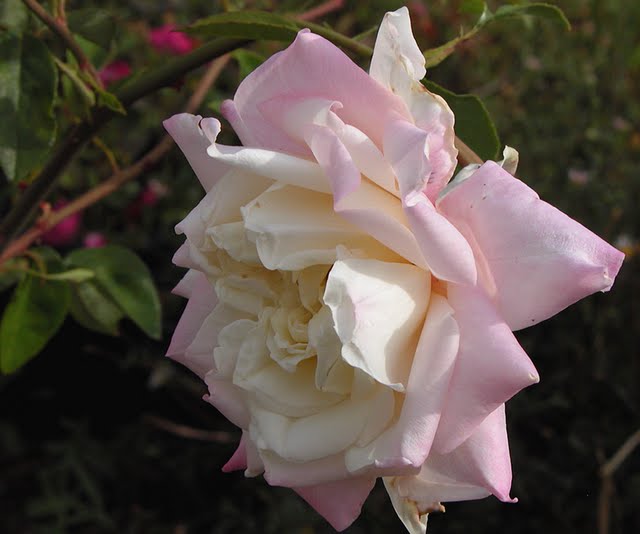
I remember visiting the nursery on one of my early visits with a climbing rose I couldn't identify. Without hesitation Keith - the resident rosearian - ID'd the flower as 'White Maman Cochet', a popular Tea Rose during the Edwardian period. Since then I have visited Honeysuckle Cottage several times a year looking for unusual plants and sage advice.

'White Maman Cochet' tea rose
Honeysuckle Cottage is a 'proper nursery' as they propagate and grow their own plants, unlike most modern nurseries who buy in stock from large wholesalers. While many nurseries have adopted the sales techniques of modern retailing (colour-themed display stands, piped music and pink uniforms) this nursery display their plants in the traditional way on the ground and in romantic disorder.

Many of the plants for sale are growing near their parent stock plants, such as the 3 metre tall Mexican Fuchsia Sage (Salvia iodantha) which on my last visit was in full bloom near the sales shed. Of course after seeing this plant I bought one after seeing its mother in her full glory. As well as Salvia the nursery has a wonderful selection of herbs, most notably lavender and thyme.

Salvia iodantha 

Co-owner Dr Judyth McLeod is a prolific author of garden and history books and many of her publications have a world wide market. I can certainly recomend her book Heritage Gardening (1994), and her more recent study of medieval gardening In a Unicorn's Garden (2008).

One of many books by Dr Judyth McLeod
All the staff working at the nursery are friendly and certainly know their plants well, and a keen gardener can easily spend an hour walking through the nursery in the company of the resident bell birds. Although not to every gardeners taste, Honeysuckle Nursery is one of the most idiosyncratic nurseries in Australia, and for those with an interest in perenials, herbs and roses it makes a must-see horticultural pilgrimage site. 

Honeysuckle Nursery is located at 30 Bowen Mountain Road, Grose Vale, NSW 2753 (tel 02-4572 1345). The nursery is open six days a week (closed Wednesday), but it's best to ring first during the week.http://www.honeysuckle-cottage.com.au/ 

Thursday, 30 June 2011

The last rose of summer

Its now mid-winter and there are hardly any decent roses in flower. Well that was what I thought until today I saw my 'Autumn Delight' in full bloom.

Autumn Delight

This beautiful rose has been in my front garden for about ten years and was purchased from Mary Davies Colonial Gardens nursery in Dural near Sydney. At the time I was looking for a low growing white rose which dated from the interwar period for my period-themed front garden. Without any hesitation Mary recomended this 1933 British raised Hybrid Musk. This rose only grows to 1 metre and has few thorns, and seems to tolerate Sydney's humid climate. I used to prune it like a Hybrid Tea in late winter but I have recently tried to resist attacking it with the secateaurs apart from regular dead heading. This shrub has an open habit and has flushes of semi-single white/cream flowers throughout the year, especially in late autumn and early winter, and makes a great alternative to the overused Iceberg rose.

Tuesday, 7 June 2011

Eryldene

I’m often asked for suggestions for gardens worth visiting for horticultural and design inspiration. One of my favourites is ‘Eryldene’ in the northern Sydney suburb of Gordon and it is often open at weekends at this time of the year.


The front garden at Eryldene
Eryldene is the former home of linguist and garden designer Professor E G Waterhouse (1881-1977). The house dates from 1913-14 and was designed by the eccentric architect William Hardy Wilson. The semi-formal front garden is a fine example of an interwar garden, and was meant to be seen from the street.  The mixed plantings of perennials, shrubs, lawn and trees sympathise well with the symmetrical design and colouring of the main house. The front garden is dominated by a large jacaranda, a tree often planted in gardens designed by Waterhouse, such as the still extant specimen he planted in the Main Quadrangle at the University of Sydney in the 1920s.

While the front garden at Eryldene contains a diverse palette of plants most of the garden is dominated by camellias. This genus was one of Waterhouse’s great loves and he propagated most of the plants in the garden. Waterhouse’s fascination with camellias saw him establish the Camellia Grove Nursery at St Ives in 1939 which helped the shrub regain popularity. The professor later became the first president of the International Camellia Society and was awarded the prestigious Veitch Gold Medal by the Royal Horticultural Society in 1966.

The Hardy Wilson designed Tea House

Both Waterhouse and Hardy Wilson were fascinated with China and one of the delights of the back garden is the Chinese influenced Tea House built in 1927. The garden is often open to the public during the weekends, especially when the Camellias are in flower as they are during winter time.

Eyldene, 17 McIntosh Street, Gordon (nearest train station Gordon)
Related Posts Plugin for WordPress, Blogger...